RCL Foods opens Quality In-service Trainee intake in Boksburg for 2026
What day-to-day work looks like in a high-volume food plant lab, how in-service training operates, and where a quality qualification leads.

The sector this sits in
Food manufacturing in South Africa is an exacting, high-volume environment. Fast-moving consumer goods (FMCG) plants run continuously to supply retail shelves across the country. In this sector, quality assurance is not an academic exercise. It is a legal, commercial, and public health barrier. If a batch of food product leaves a factory with incorrect moisture levels, incorrect acidity, microbial contamination, or faulty packaging seals, the cost runs into millions of rands in product recalls, brand damage, and regulatory penalties under South African food safety legislation.
Because production runs at speed, manufacturers rely heavily on continuous testing. Raw materials must be tested as they arrive at the receiving bay, mixtures must be tested while processing, and finished goods must be verified before palletising. This operational reality is why food producers regularly take on students completing their National Diploma in Analytical Chemistry, Food Technology, or Biotechnology.
For students at universities of technology, this period of Work-Integrated Learning (often referred to as P1 and P2) is a mandatory requirement to graduate. The industry relies on trainees to carry out high-frequency bench tests, while students gain the logbook hours and factory floor exposure required to earn their qualifications. Most FMCG facilities in industrial hubs like Boksburg operate under stringent international certifications such as FSSC 22000 or ISO 22000, meaning every test conducted must follow rigid standard operating procedures.
Advertisement
Where this role fits in the structure
In a typical production facility, the quality department operates independently from the manufacturing team. Production managers are measured on throughput and line speed; quality teams are measured on compliance and defect prevention. This creates an essential checks-and-balances system inside the plant.
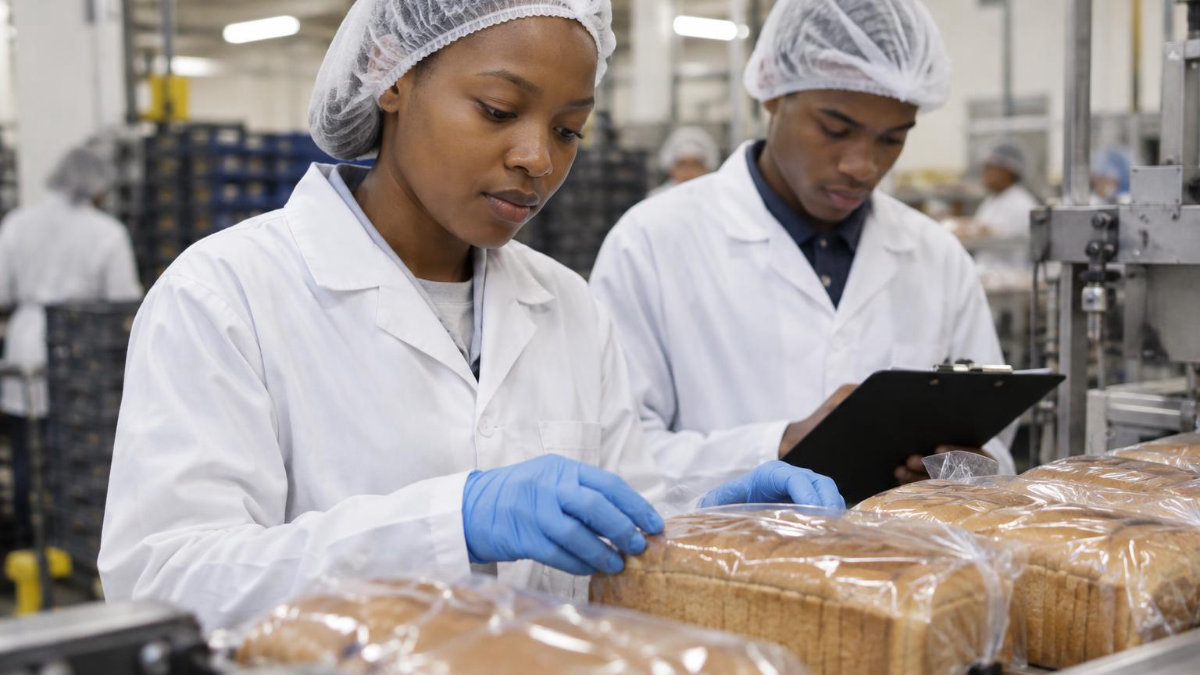
An in-service trainee in a food plant sits squarely between the wet chemistry laboratory and the active production lines. You do not spend your entire shift seated at an office desk. A standard day alternates between the testing bench and the factory floor.
On the testing side, daily responsibilities typically centre on core analytical work:
- Performing wet chemistry titrations to measure parameters like free fatty acids, salt content, or active ingredients.
- Checking physical properties such as viscosity, pH, density, colour, and moisture content across different stages of production.
- Conducting line inspections to verify that packaging dates, batch numbers, fill weights, and tamper seals meet regulatory standards.
- Preparing chemical reagents, running calibration checks on lab equipment, and maintaining clean, audit-ready bench spaces.
- Logging every test result accurately into plant tracking sheets or a laboratory information management system.
Trainees report directly to a Quality Assurance Supervisor, Laboratory Analyst, or Quality Technologist. While you are there to learn, your daily numbers matter. If a titration shows that an emulsion or mix is drifting outside specification, you have to flag it immediately to the line controller so the process can be adjusted before thousands of units are spoiled.
Advertisement
What the sector rewards in candidates
Technical knowledge of basic titrations and pipette handling is the entry ticket, but lab managers look for specific workplace behaviours when assessing trainees:
- Absolute data integrity: In food manufacturing, recording an invented or assumed number is grounds for dismissal. Quality teams need people who report exactly what the titration shows, especially when a result is outside specification.
- Punctuality and routine consistency: Samples arrive on a strict schedule based on line outputs. Falling behind creates a backlog that leaves packaging lines waiting or running blind.
- Hygiene and safety compliance: Production areas have strict zoning rules regarding personal protective equipment (PPE), jewellery, food allergens, and chemical handling. Following these rules without needing reminders is non-negotiable.
- Calm communication: When a test fails, you must deliver clear, factual information to production staff who are under pressure to keep lines running.
Many students imagine laboratory work as quiet, isolated research. Food plant labs are noisy, fast, and closely tied to shift work. Candidates who show up willing to wear safety boots, walk the line in earplugs, and handle shift patterns stand out quickly.
Realistic progression from here
Completing an in-service training vacancy allows you to submit your logbook to your university and graduate with your National Diploma. That qualification is the baseline for technical work across South African industry.
Once graduated, the immediate next step is usually a fixed-term contract or permanent role as a QC Analyst, Lab Technician, or Line Quality Auditor. In South African manufacturing, entry-level lab roles provide practical exposure to hazard analysis critical control points (HACCP), good manufacturing practices (GMP), and internal auditing standards.
Long-term progression usually diverges into two paths. Those who enjoy testing and laboratory standards move toward Senior Analyst, Laboratory Supervisor, or Quality Systems Manager roles, where they oversee compliance audits, customer complaints, and external certifications. Others pivot toward production operations, moving into line management, process improvement, or packaging technology, where an analytical background makes them strong candidates for managing factory floors.
A laboratory qualification does not automatically lead to management, and bench-level testing can become repetitive if you stay in basic quality control too long. The trainees who advance fastest are those who use their practical year to understand the wider factory: how raw materials move through the plant, why line stoppages happen, and how quality data drives plant efficiency.
View the current opportunity
Quality In-service Trainee at RCL Foods · Boksburg
View the listing and applyAdvertisement
Read next
- SAFCOL opens Risk and Compliance Internship in Pretoria for 2026What you need to know about qualifying for SAFCOL's risk and compliance graduate internship, the daily governance work involved, and how to get your application shortlisted.
- Forvis Mazars Opens Trainee Accountant CA(SA) Contracts in Durban for 2026What daily life looks like inside a mid-tier audit firm in KwaZulu-Natal, how SAICA articles work, and where the qualification takes you.
- Tiger Brands opens safety workplace experience placement in Germiston for 2026How safety and environmental graduates can use a plant-level risk internship on the East Rand to move past the entry-level experience barrier.
- SGS opens 12-month Administration Intern post in Bryanston for HR and business graduatesWhat corporate administration and reporting look like inside a testing and certification multinational, and how a YES internship shapes early career paths.
More from the FirstJobly Career Hub
Spotted a mistake? Read our editorial and corrections policy.