SGS is hiring a Junior Mineralogist in Sandton for 2026: BSc Honours in Geology required
A practical look inside the daily lab shifts, analytical instruments, and screening priorities for the junior mineralogist vacancy at SGS in Sandton.

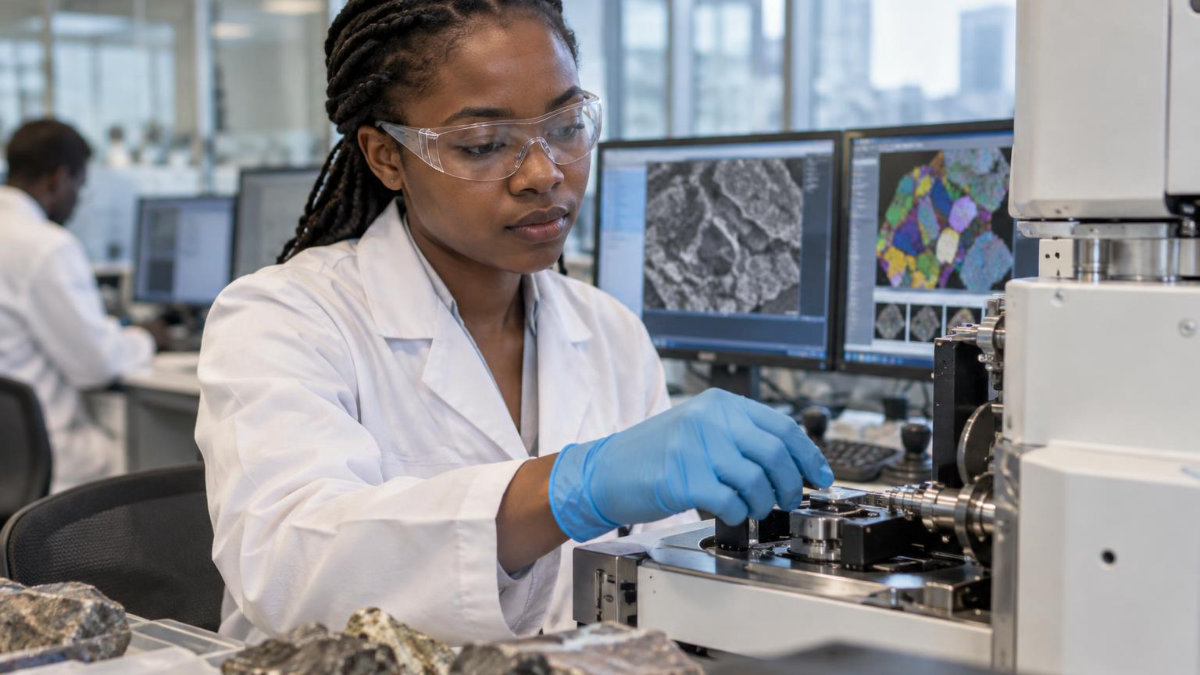
What the work actually looks like
A normal day in a commercial mineralogy facility does not start at a microscope. It starts on the preparation floor. By 08:00, you are usually checking the analytical queue, reviewing project handovers from the previous afternoon, and verifying which batches of samples have cleared crushing and milling.
Commercial testing laboratories handle materials from across the continent: drill core pulps, heavy mineral concentrates, flotation tailings, and smelter slags. Between 08:30 and 10:30, your focus is often physical preparation. You might mount fine powders into back-loading cavities for X-ray diffraction (XRD), ensuring the surface is perfectly flat to prevent peak displacement. For scanning electron microscopy with energy dispersive spectroscopy (SEM-EDS), you inspect polished resin blocks, checking for relief or scratches before running them through a carbon coater to make the surfaces conductive. Poor sample preparation ruins analytical results, so this phase demands steady hands and strict attention to dust suppression rules.
By 11:00, you move into the instrument rooms. You load autosamplers, initiate diffractometer scans, and monitor background noise and count rates. On the SEM, you calibrate beam alignment, set the accelerating voltage, and verify energy calibration using a cobalt standard. If the laboratory operates automated mineralogy systems, you set up beam parameters and field-of-view grids to map particle mineralogy overnight.
From 13:30 onward, the rhythm shifts to data processing. You take raw diffraction patterns into search-match software, identifying major crystalline phases, separating complex clay groups, and carrying out Rietveld refinement to determine mineral abundance. On SEM datasets, you group spectral clusters into defined mineral categories, checking that automated classifications match basic stoichiometry.
Late afternoons, between 15:00 and 16:30, are reserved for reporting. You compile modal mineralogy tables, cross-check calculated mineral assays against independent chemical XRF assays, and draft preliminary interpretations for a senior mineralogist or project manager to review. You sign off quality control logs, back up instrument runs, and clear your workstation before leaving.
Advertisement
Who tends to do well in this role
This position suits a geologist who prefers laboratory discipline over remote field camps and rotational exploration rosters. If your favourite part of university was optical mineralogy, petrography, or crystallography practicals, the work will feel familiar.
People who cope well in this environment share specific traits:
- They are patient with technical routines. Preparing thirty sample mounts identical in density and thickness takes patience, yet an uneven mount ruins the scan.
- They spot subtle anomalies. If an XRD trace shows an unassigned peak at two degrees theta, they do not ignore it to finish the queue faster; they investigate whether it indicates a trace pathfinder mineral.
- They understand mineral chemistry. When an EDS spectrum spikes for iron and sulphur, they calculate the atomic ratios rather than blindly trusting automated software labels.
- They accept that commercial labs operate on turnaround times. Unlike academic research, mining clients pay for rapid, accurate data to make processing decisions on active plants.
Candidates who struggle here are often those who expect every day to involve regional mapping or who get restless sitting in quiet, climate-controlled instrument rooms for six hours at a stretch.
Advertisement
What the employer is really screening for
Commercial analytical firms in South Africa use the two-year experience requirement to filter out candidates who only know mineralogy from lecture slides. While a BSc Honours in Geology proves you understand rock-forming processes, technical managers want to know if you can operate high-value equipment without damaging it.
When hiring teams review an application for a mineralogy vacancy in Sandton, they evaluate practical competency across several specific areas:
- Fundamental instrument care: knowing how to change sample carousels, detect vacuum leaks on a scanning electron microscope, and monitor detector temperatures.
- Data validation: understanding how to reconcile mineralogical data with bulk chemistry. If a client sent a copper concentrate and your mineral balance predicts three percent copper while the assay laboratory reports fifteen percent, you must recognise that discrepancy immediately.
- Laboratory quality standards: familiarisation with ISO 17025 operating procedures, calibration records, and chain-of-custody protocols for exploration samples.
- Clear technical writing: drafting findings in straightforward language so that an extraction metallurgist or mine planner can use the data directly.
In interviews, expect technical questions about diffraction geometry, how peak overlaps complicate quantitative XRD, and how you distinguish between polymorphs. If you have run instruments during your Honours project or early employment, highlight the specific makes, software packages, and calibration routines you handled.
Where it can lead
Starting as a junior mineralogist in a major commercial testing house gives you exposure to almost every major commodity in Southern Africa: gold, platinum group metals, base metals, manganese, and battery minerals. That breadth is hard to get on a single mine.
Within two to four years, competent juniors usually move into full mineralogist or senior analyst roles, managing their own analytical projects and signing off client reports. From there, career paths split.
Some professionals remain in laboratories, moving into technical management, laboratory quality direction, or automated mineralogy specialist tracks. Others leverage their data skills into process mineralogy and geometallurgy, working directly for mining houses to help plants improve metal recovery rates. The role also provides solid groundwork for registering as a Professional Natural Scientist (Pr.Sci.Nat.) with SACNASP, which is essential for signing off technical reports under international reporting codes.
View the current opportunity
Junior Mineralogist at SGS · Sandton
View the listing and applyAdvertisement
Read next
- Valterra Platinum is hiring a planned maintenance administrator in Mokopane for 2026A technical office vacancy at Mogalakwena Mine offers early-career administrators a clear doorway into large-scale mining engineering operations.
- OUTsurance opens Sales Advisor vacancies in Centurion with Grade 12 requirementDirect insurance sales roles offer structured training and commission potential, but success depends on dealing with high call volumes and strict financial compliance rules.
- Valterra Platinum opens underground fitter vacancy in Thabazimbi for 2026A practical look at the underground mining environment, technical expectations, and career progression for qualified fitters applying in Limpopo.
- Pick n Pay is hiring a deli assistant in Sandton with no experience required for 2026What the Pick n Pay On Nicol deli role demands in practice, which requirements are strict, and how to position your application without prior counter experience.
More from the FirstJobly Career Hub
Spotted a mistake? Read our editorial and corrections policy.