Vision Elevators Opens Cape Town Lift Technician Trainee Programme for N6 Candidates
A breakdown of what a four-year lift apprenticeship in Cape Town involves, how technical testing works, and where the trade leads.

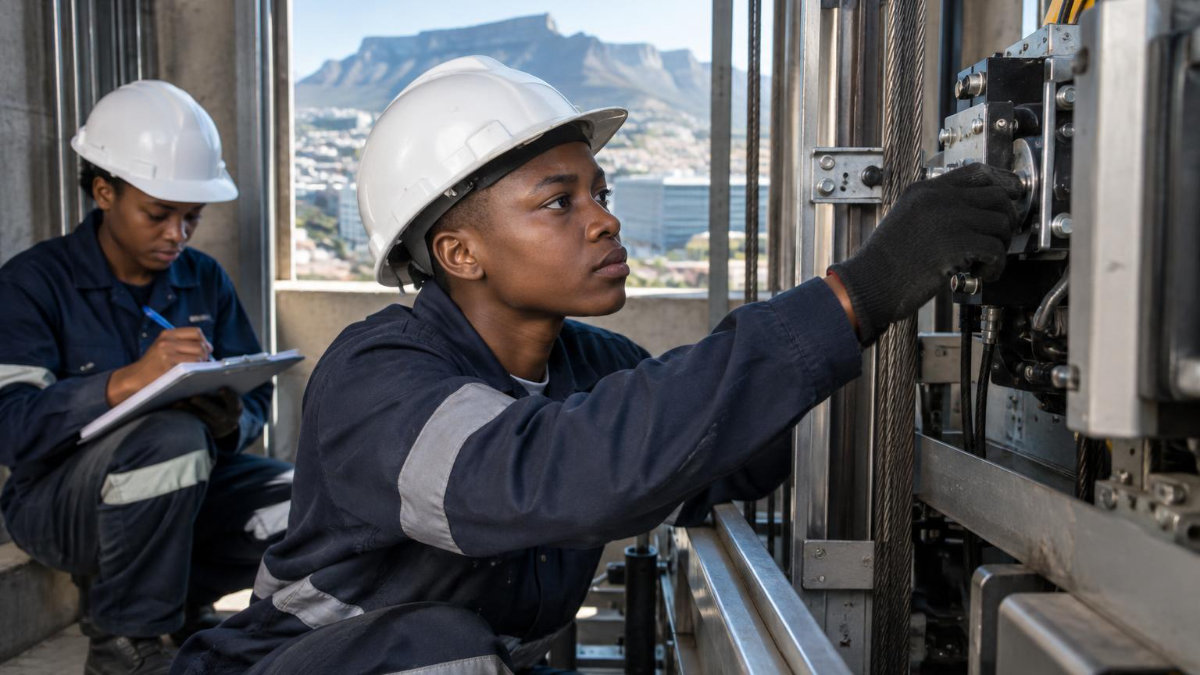
The elevator and vertical transport sector
Elevator maintenance and installation sits at the crossroads of commercial construction, property management, and specialised electro-mechanical engineering. In South Africa, vertical transport is strictly regulated under the Occupational Health and Safety Act and applicable SANS codes. Every passenger lift, goods hoist, and escalator in an office block, shopping mall, hospital, or residential complex must undergo scheduled servicing and independent statutory inspections to carry passengers legally.
Because building owners face severe legal liability if safety mechanisms fail, maintenance contracts run continuously regardless of broader economic downturns. This makes the lift maintenance industry noticeably more stable than general building construction. When new construction slows down, the national base of existing lifts still requires routine monthly servicing, component replacements, and 24-hour breakdown support.
In the Western Cape, demand is anchored by dense commercial nodes in the Cape Town CBD and Century City, industrial plants in the northern suburbs, and modern multi-storey residential projects along the Atlantic Seaboard. Companies in this space divide their operational resources between installation projects on construction sites and ongoing service contracts across mature buildings.
Advertisement
Where this trainee role fits in the operational structure
Within an elevator company, operational field teams are usually split into three divisions: new installations, modernisations, and routine maintenance. A trainee mechanic enters at the base of this technical structure, working under the direct supervision of qualified lift mechanics.
This training vacancy is specifically tailored for technical graduates who hold theoretical credentials, such as an N5 or N6 certificate, and need structured, long-term exposure to complete their trade qualification. You are not handed a company van and an independent route on day one. Instead, you work as a secondary technician on active job cards, learning how theory applies to live hardware.
Daily field work is physically demanding and takes place in confined, hazardous spaces. Technicians spend their days in dark lift shafts, overhead motor rooms, and greasy pit bases beneath the car. Typical trainee tasks on site include:
- Inspecting safety gear, overspeed governors, and door interlock contacts.
- Tracing wiring diagrams to diagnose intermittent electrical faults or relay failures.
- Checking brake clearances, lubricating guide rails, and inspecting steel hoisting ropes for wear.
- Taking multimeter readings across electrical circuits and logging service results for the lead artisan.
In this environment, a trainee acts as an essential set of hands while building the practical competencies required to work safely around high-voltage power and suspended mechanical loads.
Advertisement
What the lift industry tests for and rewards
Because human life depends on the integrity of elevator safety chains, this sector does not tolerate guesswork. Recruiters and engineering managers look for precision, disciplined habits, and solid numerical grounding over polished interview talk.
Initial shortlisting for lift apprenticeships often involves written technical assessments covering basic mathematics, electrical principles, and spatial reasoning. The industry values candidates who can read a circuit schematic, calculate electrical loads, and explain why a system works rather than just memorising answers.
Once in the field, employers look for three specific qualities:
- Methodical troubleshooting: When a lift breaks down, erratic parts-swapping costs money and wastes time. Strong technicians systematically trace faults using schematics, multimeters, and logical elimination.
- Strict adherence to safety protocols: Working next to counterweights, exposed 380V three-phase electrical supplies, and deep drop hazards leaves no room for casual shortcuts. Taking personal lock-out and tag-out procedures seriously is mandatory.
- Composure under pressure: Lifts break down during peak hours when passengers are waiting or building managers are irritated. Technicians who remain patient, communicate clearly, and focus on the technical fault perform best in the long run.
Realistic career progression from a lift apprenticeship
Completing a four-year training programme in the lift industry leads toward qualifying as an artisan lift mechanic through a formal trade test. Unlike general electrical or mechanical fitting, lift mechanics hold a scarce, highly regulated qualification that protects them from casual labor competition.
Newly qualified mechanics usually take over dedicated maintenance routes, managing between 40 and 80 installations in an allocated zone. They work independently, responding to emergency call-outs and performing monthly preventative maintenance.
Beyond basic route maintenance, technical careers branch into specialised tracks:
- Commissioning technician or adjuster: These senior specialists test, program, and fine-tune complex variable-frequency drives, microprocessor controllers, and safety circuits before a newly installed or modernised lift is handed over to the client.
- Registered lift inspector: Experienced artisans can complete further legal and statutory credentials to inspect and certify lifts on behalf of regulatory authorities and insurance bodies.
- Technical management: Senior field specialists frequently move into field service supervision, technical training, project management, or depot operations.
Because modern vertical transport machinery relies on universal electrical and mechanical engineering standards, a recognised lift qualification also opens opportunities for skilled South African technicians across international markets.
View the current opportunity
Lift Technician Trainee at Vision Elevators (Pty) Ltd · Cape Town
View the listing and applyAdvertisement
Read next
- Eskom opens three-year electrical apprenticeship across North West with no work experience neededHow to approach the Eskom electrical apprentice intake across five North West towns when your CV has technical subjects but zero formal work history.
- Sasol Millwright Apprenticeship 2026: Train as an Electro-Mechanic in Secunda and SasolburgA trade apprenticeship for matriculants and N3 holders who want a qualified artisan trade. Here is who qualifies, what the training covers and how selection works.
- MAN Automotive Apprentice Diesel Mechanic Learnership in Bloemfontein Closes September 2026MAN Automotive is accepting applications for an Apprentice Diesel Mechanic Learnership based in Bloemfontein. Trainees will gain practical experience in heavy commercial vehicle maintenance under qualified mentors.
- City of Johannesburg opens food value chain internship paying R10,109 a month for 2026What the City of Johannesburg looks for in food value chain intern applications, how municipal shortlisting works, and how to prepare your paperwork.
More from the FirstJobly Career Hub
Spotted a mistake? Read our editorial and corrections policy.