Afgri Trainee Parts Salesperson vacancy in Pietermaritzburg opens for matriculants with a licence
How agricultural equipment dealerships run their parts counters, what trainees actually do on the floor, and where entry-level parts roles lead in South Africa.

This application period has closed.
The listing this article was written about is no longer accepting applications. The guidance below can still help you prepare for the next intake.
The sector this sits in
Agricultural equipment dealerships operate under intense seasonal rhythms that standard automotive retail rarely experiences. When a combine harvester or commercial tractor breaks down in the KwaZulu-Natal Midlands during planting or harvest, the farmer cannot wait days for a replacement component. Every hour the machine stands idle costs money. Because of this, agricultural dealerships like Afgri maintain specialised branch networks across farming hubs, stocking thousands of individual part lines ranging from simple hydraulic seals and filters to complex electronic sensors and transmission assemblies.
Pietermaritzburg functions as a major logistics and service nexus for both timber and mixed farming operations across the KZN interior. Agricultural mechanisation businesses in this region must bridge two distinct worlds. On one side are massive international machinery brands with exacting digital parts catalogues, rigorous warranty procedures, and complex inventory management software. On the other side are local farmers, contractors, and workshop technicians who walk up to a counter needing an immediate, practical solution to an urgent mechanical failure.
This operating environment makes the parts department the engine room of dealership profitability. Dealerships often make tighter margins on the initial sale of heavy machinery, relying heavily on aftermarket service, routine maintenance, and ongoing parts supply over a machine's ten or twenty-year working lifespan. Entering this sector means stepping into technical retail where product knowledge, speed, and logistics matter far more than smooth sales talk.
Advertisement
Where this role fits in the structure
In a typical machinery dealership, the branch is split into three core operational pillars: whole goods sales (the teams selling complete tractors and implements), the service workshop (the qualified diesel mechanics and field technicians who repair them), and the parts department.
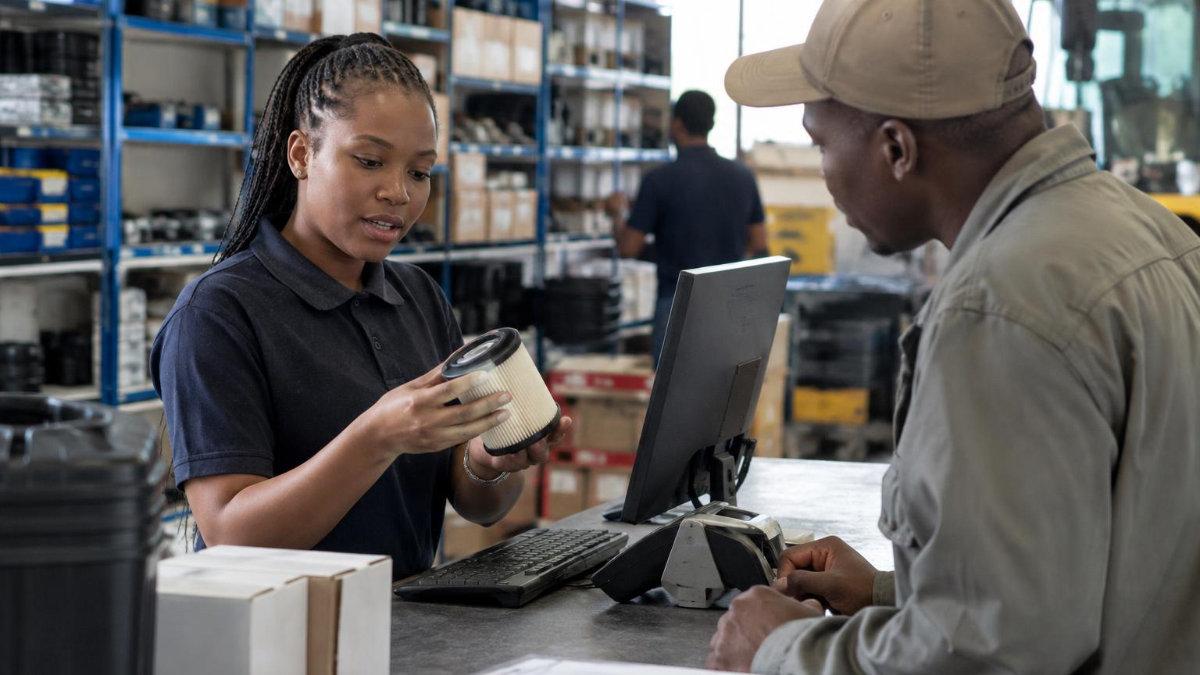
The parts department sits directly between the workshop and the public counter. An entry-level trainee parts salesperson does not immediately start advising clients on complex rebuild kits independently. Dealerships use the trainee position as an apprenticeship in inventory discipline, catalogue literacy, and counter service. You sit at the operational bottom of the parts division, reporting to a parts manager or senior parts sales executive, with daily work divided across three main areas:
- Counter support and customer handling: Answering walk-in queries from farmers, taking calls, locating standard service items, and learning to read electronic parts catalogues accurately.
- Goods receiving and warehouse operations: Unpacking daily consignments from central distribution centres, checking delivered stock against delivery notes, reporting discrepancies, and packing items into their designated bin locations.
- Workshop liaison: Pulling requested parts from the shelves for internal workshop job cards so that dealership mechanics have the components they need before they start stripping a machine.
Most newcomers to dealerships do not realise that counter sales work is deeply tied to warehouse management. You cannot sell parts effectively over a counter until you know where they live in the warehouse, how stock is categorised, and how the dealership's enterprise software tracks every bolt, washer, and belt.
Advertisement
What the sector rewards in candidates
Unlike pure retail clothing or supermarket work, parts counter sales requires a strong appetite for technical details. Dealerships screen candidates for a specific mix of aptitude, temperament, and basic mobility.
First, accuracy trumps charm every day of the week. Ordering or handing out a part that is one millimeter off-spec can cause thousands of rands in mechanical damage or leave a field service technician stranded fifty kilometres away on a farm with the wrong part. The sector rewards people who double-check serial numbers, cross-reference parts manuals, and verify engine codes before issuing stock. If you are naturally methodical and pay close attention to codes and numbers, you will find this work straightforward to master.
Second, resilience under pressure is non-negotiable. Agricultural clients dealing with machinery breakdowns are often stressed, tired, and running against tight weather windows. Counter staff must stay calm, listen carefully, and remain patient when an agitated customer cannot clearly describe the exact bracket or hose they need.
Third, basic mobility matters. Agricultural parts departments require staff to move stock, shift heavy crates, and occasionally run parts out to clients or field technicians. A valid driver's licence is a mandatory baseline for this reason. Dealerships cannot carry counter staff who cannot legally drive a company bakkie to collect urgent stock or make emergency drop-offs.
Prior experience in a parts department or warehouse is always welcomed by branch managers, but at the trainee level, hiring managers in South Africa frequently hire based on attitude, computer comfort, and how cleanly you present yourself. Candidates who can communicate clearly in English, show basic technical curiosity, and demonstrate reliable attendance usually beat candidates who have casual experience but poor reliability.
Realistic progression from here
A trainee role in a major equipment dealership offers one of the most reliable entry routes into formal aftermarket logistics without a university degree. It gives you direct, daily experience with inventory systems, technical warehousing, and commercial client interaction.
Within twelve to twenty-four months of consistent performance, a trainee typically moves up to a full parts salesperson role. In that position, you handle your own customer accounts, carry sales targets, handle counter invoicing independently, and often earn commission or performance incentives alongside a basic salary.
From a full parts salesperson position, the career path splits in several clear directions across the South African machinery and automotive industry:
- Senior counter sales and key account management, dealing directly with large commercial farming estates and fleet contractors.
- Inventory controller or warehouse supervisor, focusing on branch procurement, stock turns, audit compliance, and logistics.
- Parts manager, taking complete operational and financial responsibility for the branch's parts revenue, stockholding, and counter staff.
- Workshop service advisor, moving across the hall to manage repair bookings, client job cards, and mechanic scheduling.
The technical grounding you gain from reading machinery manuals and handling high-value parts is portable. Experience gained at an agricultural machinery dealership transfers directly to commercial truck dealerships, mining equipment suppliers, earthmoving franchises, and industrial parts distributors across Southern Africa.
Find a similar opportunity
This application period has closed. Similar roles are posted on FirstJobly most days.
Browse current jobsAdvertisement
Read next
- Montego Pet Nutrition is hiring a permanent cleaner in Centurion: Matric requiredWhat industrial cleaning roles in food manufacturing actually demand day to day, how factory hygiene works, and where starting on the plant floor can lead.
- The Building Company is hiring a cashier in Mbombela with Matric as the baseline requirement for 2026A cashier role at a building merchant is more practical than standard retail. Here is how to apply without formal till experience and what the job teaches you.
- Montego Pet Nutrition is hiring a General Worker and Driver's Assistant in Durban for 2026This entry-level distribution role requires a Matric certificate and physical stamina, offering school leavers a direct entry point into road freight logistics.
- Overberg Water Board General Worker vacancy in the Western Cape open for Matric holders with Code 08 licenceWhat daily life at a regional water utility actually involves, how public water boards screen applicants, and how an entry-level operational job can lead to a formal trade in water treatment.
More from the FirstJobly Career Hub
Spotted a mistake? Read our editorial and corrections policy.